Pages

Showing posts with label graduate school. Show all posts

Monday, February 9, 2015

A little backpedaling

[I edited this when I realized I had missed an entire person!]

I was at dim sum on Sunday with a bunch of Wellesley alums, most of whom were fairly recently graduated. And I start going into my bitter spiel about "don't go to graduate school, it just drains your twenties away and leaves you no better off, etc etc..."

Which, in many ways, was true for me.  But was that graduate school, or me?

Friday, October 17, 2014

A Cautionary Tale? Or an Inspiration? Both?

I was asked to discuss my career path by the career center at my undergraduate institution.  Since I feel like a scrambler more than a planner at this point, I found that quite funny, but tried to answer their questions truthfully (if optimistically).

Here's the result! 

Friday, October 10, 2014

Fall: The Academic Job Season

I let my MLA membership lapse this year, stopped going to conferences a year ago, quit pursuing academic publications in favor of writing ones for places that paid. I gave the job market three tries, and never even got a request for an interview. Which, looking back, makes plenty of sense -- despite the importance of doing so, I never published a peer-reviewed article. What was I thinking? But in the end, that pushed me back out into a life that might turn out to be a better fit.

I got a new job that I love, as associate editor for the literary magazine and eponymous press Two Lines (look how pretty our covers are!). How lucky is that? What a dream opportunity to work with incredibly well-read colleagues who genuinely care about poetry and avant-garde literature. I'm working out this life that's part reading and writing, part editing, part adjuncting for the best program on the planet for adjuncts: the Fall Program for Freshmen, run by UC Berkeley Extension for spring admit Berkeley freshmen. Teaching smart kids, editing literature, writing for fun and money -- all good. I even teach and hold office hours in Wheeler Hall, which is also the home of the English dept at Berkeley.

Then I opened an email a month ago about local jobs in higher ed .

Thursday, May 30, 2013

Money and Motivation

One of the ways in which spending your twenties as a grad student in a humanities department warps your view of yourself and your world is with regard to self-value. Not just "I must be a shitty person and scholar because I don't get this 'body without organs' " deal, but the work we do for which we are not paid, and the work for which we get paid so very, very little.

In graduate school, I planned events, I entered data, I taught myself software programs, I compiled webpages, I proof-read, I managed other graduate students, I researched, I read, I wrote, and I taught.

And for few of these gigs was I paid, and then, it was not well. This translates well to academia, where service and research are the perqs that you earn by teaching. You are grateful to be able to have the time and space to voluntarily, on your own time, research, serve on committees, mentor students, etc.

But this mindset, I am finding, is counter to everything outside of academia. I do not think the importance and value of a job can be measured by its salary. I do not think that those who earn $30,000 must or should work less hard than those who earn four times that. So that's good. But this belief in dedicating all to a job -- and in editing and writing "on the side" of the "real" job -- is not always helpful to getting ahead. I ask myself, is my genuine wish to work longer hours than I am paid fair to me and my partner? Really, I should be compensated for all time worked, so am I being a sucker by gladly bringing work home with me? Or since I am young and trying to build a career, should I be grateful for everything and anything I can get?

What's the difference between an underpaid, part-time editor working harder than s/he's being paid for and a young engineer at a startup sleeping at the company HQ and dedicating him/herself to their launch date? Is it just money? compensation? prestige? Or are they both naive, in fact, and should be rallying with other workers to demand fair wages?

One of the consequences of our new economy seems to be both flexibility and instability. If we are all eminently replaceable, we each must always be working harder than we are being paid in order to be the most valuable person to the company, it seems to me. Maybe all of the American economy is just catching up to a trick that academia's been playing on its citizens for many decades longer.

Tuesday, May 28, 2013

Where I am today

I finished my dissertation at 10 AM on March 28th, 2013. I was so worn out by the end that I am not sure that finishing was either a relief or a moment for celebration. It was more of a "This? This is what I had to do? All those years of paralysis and confusion and all I had to do was this?"

I felt let down by myself and, to be perfectly honest, by my advisors. I'm very proud of three of my chapters and I am glad I finished the last one and the intro. But, I am disappointed that despite my grand, ambitious ideas for the shape of the dissertation, it ended up being 200 pages, intro + 4 single author chapters. What a yawn. I don't want to know how many errors were in the bibliography. I still feel like as much of an impostor as I did throughout the process, only now I have a degree I feel like I earned through sheer forbearance rather than skill or knowledge. I don't think I know more now than I did six months ago, I just finally put my thoughts on paper. I feel like I wandered blindly for so long and spent so long worrying about their responses that I wasted years. One of my committee members apparently did not know when the submission deadline was and gave me feedback to totally revise my intro three days after I had submitted the document. I don't blame him at all -- I hadn't given him much time in the end to respond.

One of the unconscious reasons behind procrastination, for me, is that by cutting down on the time given to my advisors, and limiting the time I had left, I knew that they couldn't ask me to do huge revisions. Even if that would have been better for the scholarship. There simply wouldn't be time, so we band-aided the poor diss and shuffled it off stage.

I decided to embargo my dissertation for the maximum time allowed, two years, partially because I am telling myself that I will publish better versions of my chapters, and partially because I am deeply ashamed that it isn't better. I had the chance to really study under my advisors, and I never took it because I was too afraid of their criticism and felt too stupid to engage them in real, deep conversations about poetry, literature, and theory. I never even read half the books I wanted to, and what is a sadder take away from eight years of graduate study of literature?

I hope to revise my intro over this summer, and maybe tack on that last conclusion I intended to write, and correct any glaring typos or bibliographic problems. I also would like to turn some of the lost material into articles -- the chapter on the state of the poetry-publishing industry in Ireland and my Heaney/Boland chapter that never materialized.

I want to apply for academic jobs this fall, even though I got nowhere last year. But my current editorial job is looking shaky -- the publisher is in some financial straits, and I'm not sure my direct boss is going to stick it out. I feel very nervous, and I need to find some work immediately in case everything goes pear-shaped, which is pretty hard to do when you are new-ish to both an area and an industry.  We'll see.

Friday, March 15, 2013

Mad Dash

I have had about ten days to work  on my introduction, and got about fifteen pages written -- all of which summarized Irish history -- which took a lot of work. Then I had a meeting with the helpful professor at the local campus, who strongly suggested that this was going to be too broad and too long and wasn't a real introduction to my project.

So, what I need to do instead is explain my argument and the reasons for it. In other words, do exactly what is so difficult that I do everything I can to avoid it. I would much rather just summarize Irish history for a while and hope that explains why I am doing my study. That meeting was on Tuesday, and I've just been clenched up in anxiety and frustration since then. I think I've written half a sentence since. I was supposed to turn this in yesterday, and instead it's almost two and I've got half a sentence done. I feel sick to my stomach with how hard this is going to be and how little time I have to do it in. My main argument is "this is different! and cool! just like Ireland!" and I've been repeatedly told this isn't a good enough thesis, which is one of the things that disenchants me about academia. Why does a close reading + historical context-based reading have to say anything other than "look at what I found"?

Tomorrow is full, too: I had a sealant recently applied by the dentist crack so I had to make an emergency appointment. My back hates me spending 12 hours at my deck, so I need to get a massage, and I was supposed to have lunch with a colleague tomorrow, but I didn't realize we had a dinner scheduled with friends. My boyfriend doesn't want me to skip out on our regular dinner with friends, so pushed me to cancel my lunch instead. I strongly do not want to attend this dinner. I want the hours to work or sleep. I don't care as much about these regular dinners as he does, probably because they are more his friends than mine.

I tried to get up early today to work, and I did read an essay that was great, but I really didn't sit down to write until 6 PM, in my usual fashion. I genuinely don't know what happens to me during daylight hours.

I've taken the last two weeks off from the publishing gig to work on my diss, and apparently there have been numerous crises. I am looking forward to digging back in, but having these two weeks off has also been great. I am not exhausted at 5 PM, I don't have to show up anywhere at a particular time, my boyfriend is also working from home, so we get to hang out, and I haven't had to negotiate once. Back on Monday, though.

Monday, March 11, 2013

Typography and Book Design

I am mostly an amateur enthusiast when it comes to book design and typography. I have handset letterpress and made my own very tiny book, I have read guides on typography (for fun, mind you), and have studied the material construction of books of poetry as part of my dissertation. So, I know the terminology, but I have not worked with inDesign, I've never worked with commercial printers, nor have I worked within comercial constraints.

Still, I have OPINIONS -- of course I do. And when our galleys came back with a half inch, max, of margins, 12-point Times New Roman font, and single spacing, I nearly flipped. I've already explained several times that you can't use a regular old serif typeface (ahem, "font" so I don't sound like a ponce) as your typeface for a title. And that you should match your title page and chapter headings closely in spirit to the typeface used on the cover. All you have to do to know that is look at literally ANY decent book.

These galleys looked like someone just took a Word file and printed it -- which was basically what was done. I felt bad, because it had looked fine as a PDF, so I OK'd it. It was astonishing how different it looked on screen and in print. Amazing how cramped and dense 35 lines per page looks compared to 25.

I think one thing my grad degree has taught me is how to learn the conventions of one's genre, and how to appear to belong. And how to teach yourself everything, since no-one else will do it for you. So I get frustrated when people don't do that.

Monday, January 28, 2013

Woman Meets Perfume: Life after grad school

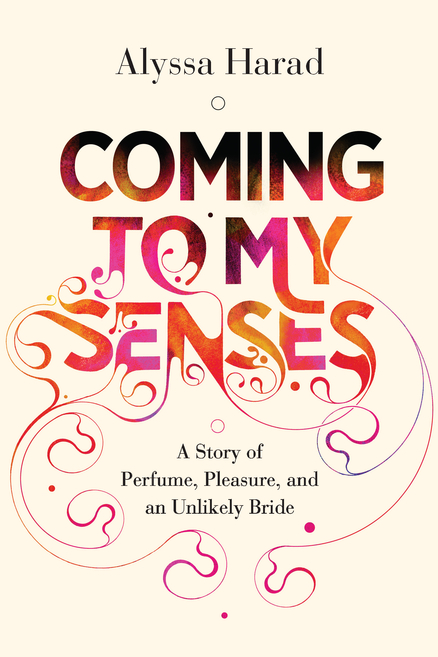
I was stopped by a stunning book jacket in Pegasus Books today:

Isn't that gorgeous?

I literally was only paying attention to the jacket and title page design (which was a flawless interpretation of the jacket) as an example of the way in which the typeface on the title page should echo that of the cover (well done Random-Penguin)....


.... but it turns out Harad's book is the story of a UT Austin Ph.D. in English who takes a bow and whisks herself off the academic stage to another life! I am inspired! After the million books on lyric, Irish politics, and publishing I have to read, and the towering pile of MSS, this is next on the list.